
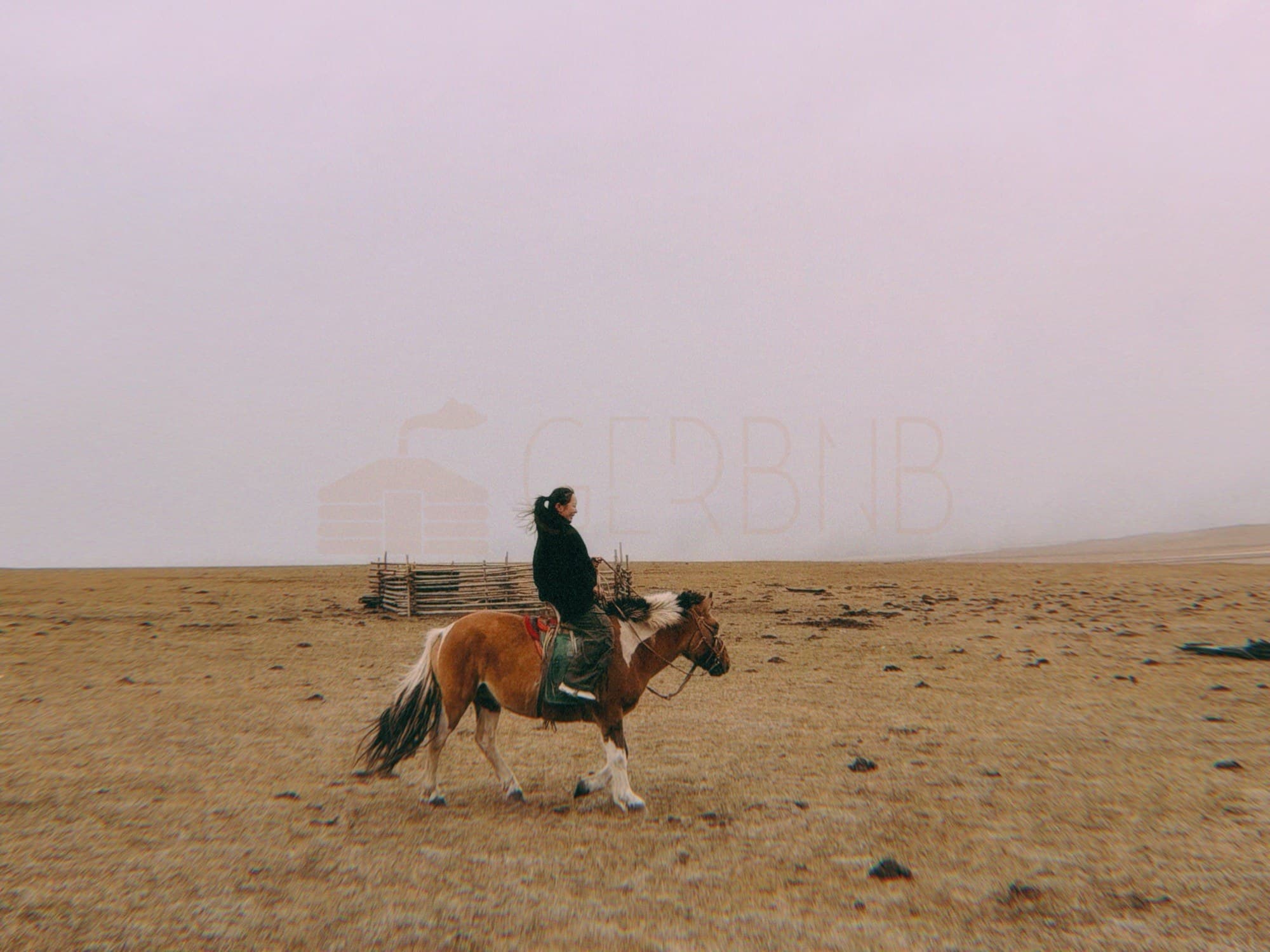
The simplest way to see Mongolia by horse is to stay with a herding family and ride out from their ger (yurt). Every GerBnB host family keeps horses and offers rides. Riding is paid by the hour, roughly 25,000–40,000 MNT per hour (about $7–11) depending on the host, and is never included in the nightly price. Beginners are mostly welcome with the host or a guide riding alongside. Expect small, half-wild horses, wooden or homemade saddles, no helmets and no arena.
This page covers what Mongolian horses are like, how a ride from a family ger differs from a multi-day trek, who it suits, what it costs, what to bring, how to behave around the herd, and when to go.
Why Mongolia is called a horse country
Horses are part of daily work in the Mongolian countryside. Herders use them to move and watch sheep, goats, cattle and other animals across open pasture, and children often learn to ride very young. Mongolia has more horses than people.
The horse also sits at the center of the culture. Horse racing is one of the three "manly games" of Naadam, the national summer festival, alongside wrestling and archery, and the jockeys are usually children. Mare's milk is fermented into airag, a mildly alcoholic drink served to guests in summer. The horsehead fiddle, the morin khuur, carries a carved horse head on its neck.
What Mongolian horses are like
Mongolian horses are short and sturdy, with thick necks, heavy manes and large heads. Most are pony-sized by Western standards, but riders call them horses, and so do herders.
They are bred for endurance, not speed over a short track. They live outdoors all year, find their own grazing, and survive winters far below freezing without stables.
Most herds are semi-wild. Horses graze freely on the steppe in groups and are brought in when needed. Sometimes the family's herd is grazing far from the ger. A horse that is ridden often is usually calm. A horse that is rarely handled may be nervous with strangers. Do not expect a horse that behaves like a riding-school pony.
Riding with a nomad family compared with a multi-day trek
A multi-day horse trek is a guided expedition. You ride for several days between camps, usually with a guide, a support vehicle or pack horses, and tents. It suits people who want distance and are ready for long hours in the saddle.
Riding from a family ger is smaller and more personal. You stay with the family and ride out from their pasture. Between rides you eat with the family, watch the milking and see how the household works.
Rides can be short or long. Some guests ride for an hour. Others ride four hours in the morning and four in the evening, or take a full day.
Hosts work in two ways:
- Guided hosts. More experienced riding hosts require a paid guide who rides with you, for example one guide for every two guests.
- Relaxed hosts. Other families are more informal. When they have time, a family member rides along with beginners. A confident rider may be able to take a horse out alone for the whole day.
We confirm which style applies before your stay.
What riding with GerBnB hosts looked like this summer
- Bolor-Erdene's family at Elsen Tasarkhai rides out to the sand dunes. Guests can switch to camels to cross the dunes, then come back to the horses for the ride home. Bolor-Erdene's listing
- Myagmarsuren rode with a guest for the whole day. Myagmarsuren's listing
- Batzaya's family had their horses grazing in another area during one stay, so they took the guests there to ride. Batzaya's listing
If a family's horses are away in another region, the host arranges horses through neighbors or takes guests to where the horses are.
Stays with riding from the family ger are our main format. One host, Sukhbat near the Orkhon waterfall, also runs multi-day treks to the lakes, arranged through GerBnB.
How much horse riding costs with a host family
With GerBnB hosts, riding costs roughly 25,000–40,000 MNT per hour (about $7–11), depending on the host. It is paid separately and is never part of the nightly price. Hosts that require a guide charge for the guide too. Some hosts may give a discount for long rides. That is agreed directly with the host.
Beginners riding horses in Mongolia
Beginners are mostly welcome, as long as the host or a guide rides alongside. Short rides at a walk are manageable for most healthy adults. Tell the family your level before you get on, honestly. They can then pick a calmer horse and set the pace.
Experienced riders will find the horses lively and the open steppe a pleasure. Faster riding is possible with some horses, but ask first.
Children and other requirements depend on the host. Some hosts do not allow children to ride. Ask before you book.
What to wear and bring for horse riding in Mongolia
- Long trousers that do not rub, such as riding tights or stretchy hiking trousers. Jeans chafe on longer rides.
- Shoes with a small heel or sturdy boots, so your foot cannot slide through the stirrup. Avoid sandals.
- Layers. Weather on the steppe changes fast: a warm layer and a windproof or rain jacket. In winter, full cold-weather gear.
- Sun protection: hat that stays on in wind, sunglasses, sunscreen, lip balm.
- Gloves to prevent rein rub.
- A small backpack or bum bag for water and a snack, strapped tight.
- Your own riding helmet if you want one. Hosts do not provide helmets. Local herders ride without them.
- Cash in tugrik for paying the host for riding.
For everything else you need for the night itself, see what to pack for a ger stay.
Staying safe around Mongolian horses
- Approach and mount from the left side. Mongolian horses are trained to be handled from the left. Approaching from the right can startle them.
- Never walk behind a horse. Pass in front, where it can see you.
- Move slowly and speak calmly. Semi-wild horses react to sudden movement, flapping jackets and loud noise.
- Saddles. Hosts use either a traditional Mongolian wooden saddle, with a high front and back that feels hard and upright to Western riders, or a soft homemade pillow-style saddle.
- Short stirrups are normal. Ask the family to adjust them if your knees hurt.
- Listen to the family or guide. They know each horse.
- Travel insurance that covers horse riding is your responsibility. Check your policy before you go.
Riding etiquette
- "Chuu" is what Mongolian riders say to make a horse go forward.
- Do not touch a horse's head or neck without asking. Some horses are not used to it.
- Do not ride through the herd or close to young foals.
- Ask before taking close-up photos of the family's horses and children.
Best season for horse riding in Mongolia
GerBnB hosts offer riding in most months, including winter. Any limits for your dates are shared before you book.
For most visitors, late spring to early autumn, roughly June to September, is the easiest time. Grass is green and horses are in good condition. July and August are warmest but can bring rain and flies. September is often clear and cool. Naadam is held in mid-July, and many local horse races happen around that time.
Winter riding is possible but very cold, and horses are thinner after a hard season. Dress for it.
How to book a ger stay with horse riding on GerBnB
- Open the host list and filter by horse riding.
- Read the listing: food, water, charging, internet and sleeping format differ by family.
- Ask for horse riding through GerBnB, with the length of ride you want and your riding level.
- The GerBnB team checks with the host in advance and confirms whether it is possible, for how long, and with or without a guide.
- Pick your dates and book. Pay for riding to the host, at the hourly rate you agreed.
If you are unsure which family fits your riding level, use "Match me with a ger" and tell us how much you want to ride.
Where to go next
- Browse host families that offer horse riding
- Read what your first night in a ger is like: First night in a Mongolian ger